How have FIFA World Cup hydration breaks affected England's matches? What the data tells us about DR Congo, Croatia, Ghana and Panama games
By Leon Imber
Updated 01/07/2026 at 21:52 GMT+1
React to this story
'Hydration break' has become a staple of the new football lexicon after FIFA introduced the mandatory measure for this summer's World Cup. Love them or loathe them, they are here to stay for the rest of the tournament, so it is up to those teams remaining to use them in the best possible way.
Thomas Tuchel
Image credit: Getty Images
Much has been made of the breaks, which take place around 22 minutes into the first and second halves, and were said by FIFA to be introduced in the interest of player welfare at the World Cup.
Those ardently against the hydration breaks question whether this is actually the case, and disagree with teams being able to reconvene and receive instructions from their coaches over the enforced three-minute period.
Whether you like or dislike hydration breaks, the notion that matches can hinge on momentum shifts before and after the intervals creates a fascinating narrative.
Opta has collated data on how England have ranked against their opponents in terms of attacking threat throughout the 90 minutes, with interesting findings following the mid-half breaks.
Both Harry Kane - who single-handedly guided England to victory over DR Congo with a match-winning brace - and head coach Thomas Tuchel pointed towards their side's upturn after the first-half hydration break in Wednesday's 2-1 win, at which point they were 1-0 down to Brian Cipenga's seventh-minute goal.
After a turgid start, the data shows they were not only right, but also enjoyed a massive surge in momentum after the second-half break too.
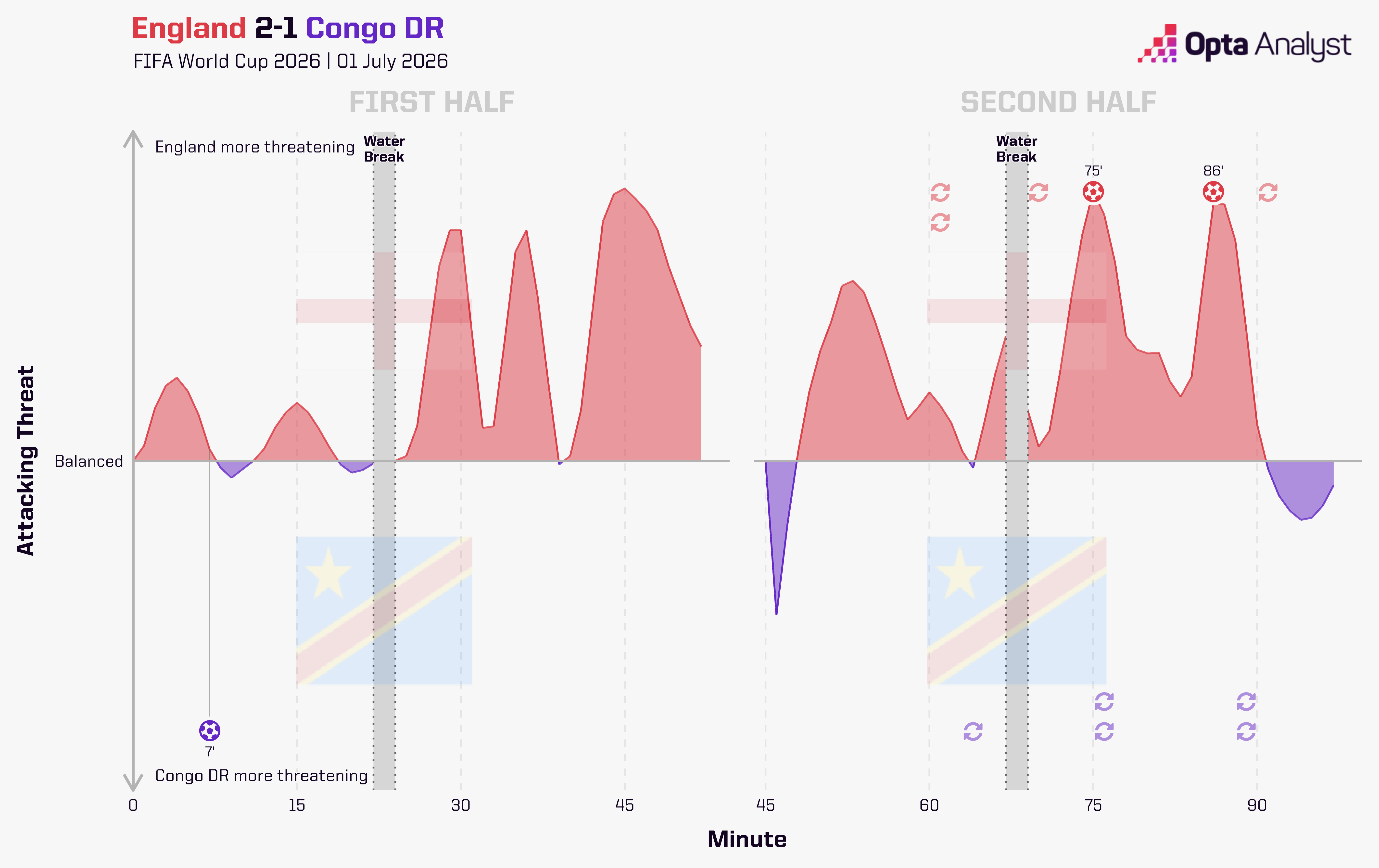
England v DR Congo, World Cup momentum graph
Image credit: Opta
"After the first water break we had three, four, five big chances, a penalty situation maybe in our favour, we kept knocking, kept knocking, knocking, knocking," Tuchel told the BBC.
"The keeper had some unbelievable saves, so it got more and more difficult, and the reaction and belief was one of a kind. They were ready to keep doing what was necessary to win."
/origin-imgresizer.tntsports.io/2026/07/01/image-721ace77-4a08-4445-8980-b146130fc262.jpeg)
Harry Kane after England's win
Image credit: Getty Images
Kane added: "After the first hydration break, we upped the level, we looked good. Their keeper made some unbelievable saves in that first half, it was just about pounding the rock, keep pounding the rock, our moments will come."
Can the same case be made for group-stage matches?
The results are not as overwhelming. And in some cases, it can be argued England's momentum suffered as a result of the breaks.
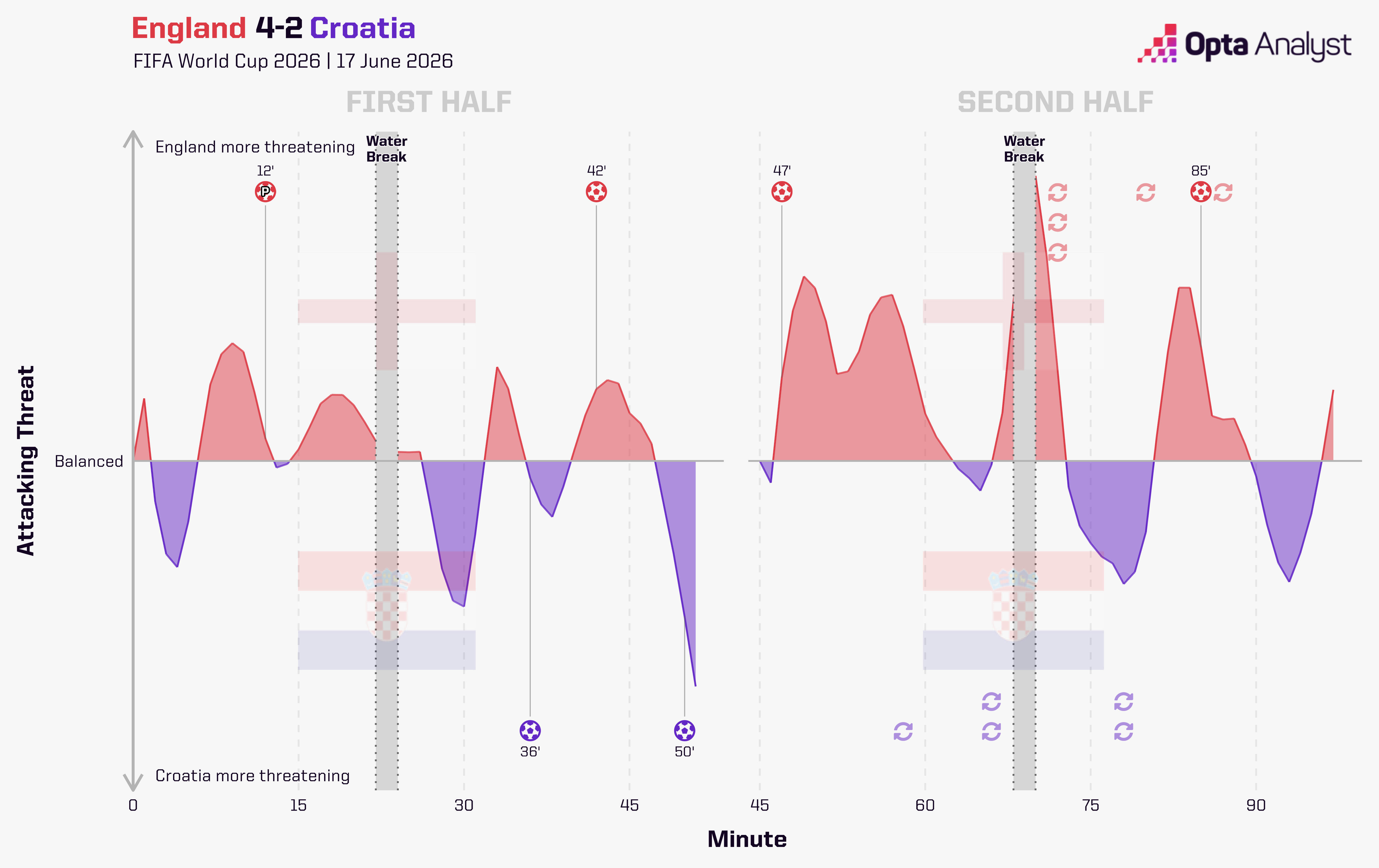
In the tournament-opening 4-2 win over Croatia, momentum shifts immediately after the hydration breaks actually turned in the favour of Zlatko Dalic's side.
England v Croatia, World Cup momentum graph
Image credit: Opta
After Kane netted his re-taken penalty to open a 1-0 lead, Croatia enjoyed an upturn after the break - culminating with an equaliser. Kane went on to score again in the first half, before Petar Musa equalised on the stroke of half-time.
The second-half hydration break came at a moment England were building serious momentum, the chart showing an overwhelming period of attacking threat in the 22 minutes after half-time, Jude Bellingham re-establishing a lead in that time.
But when the break hit, England's momentum plummeted. Croatia got back on the ball, but they could not turn their pressure into meaningful efforts at goal - and England substitute Marcus Rashford scored to create a two-goal cushion.
- Should England have had a penalty? Kane fumes, Hart surprised
- How Kane's 'hero moment' lit up England's 'best game of the tournament'
Game dynamics have to be factored in, and it was inevitable that Croatia would have a surge of attacks while chasing the single goal, especially as they brought on forwards Marco Pasalic and Igor Matanovic shortly before the drinks break.
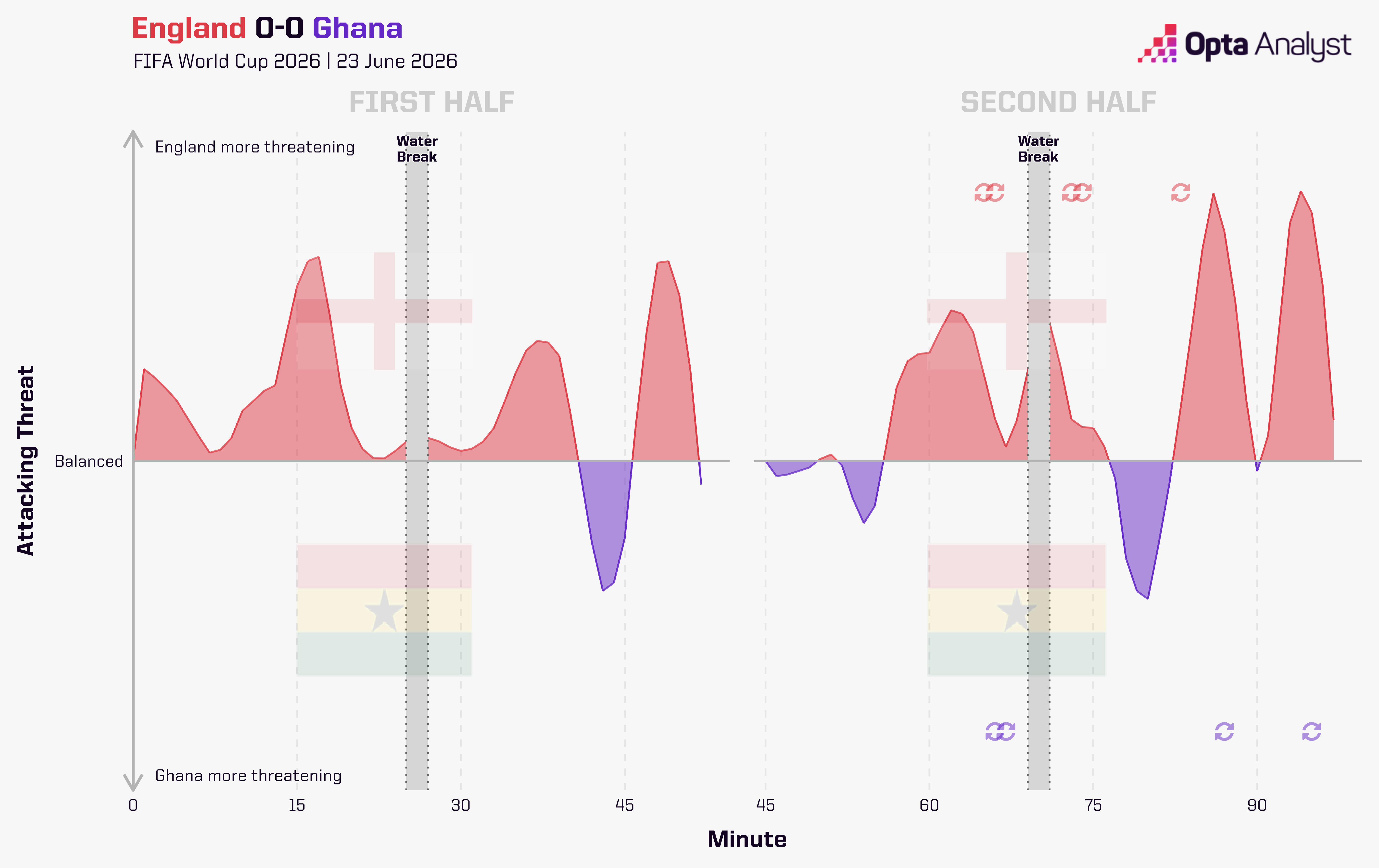
The subsequent 0-0 draw with Ghana was very much a non-event, with England struggling to break down their rigid counterparts who deployed a stubborn low block.
The momentum chart shows little in the way of any England upturn after the hydration breaks, even showing Ghana's best moment of the match came shortly after the second-half stoppage.
England v Ghana, World Cup momentum graph
Image credit: Opta
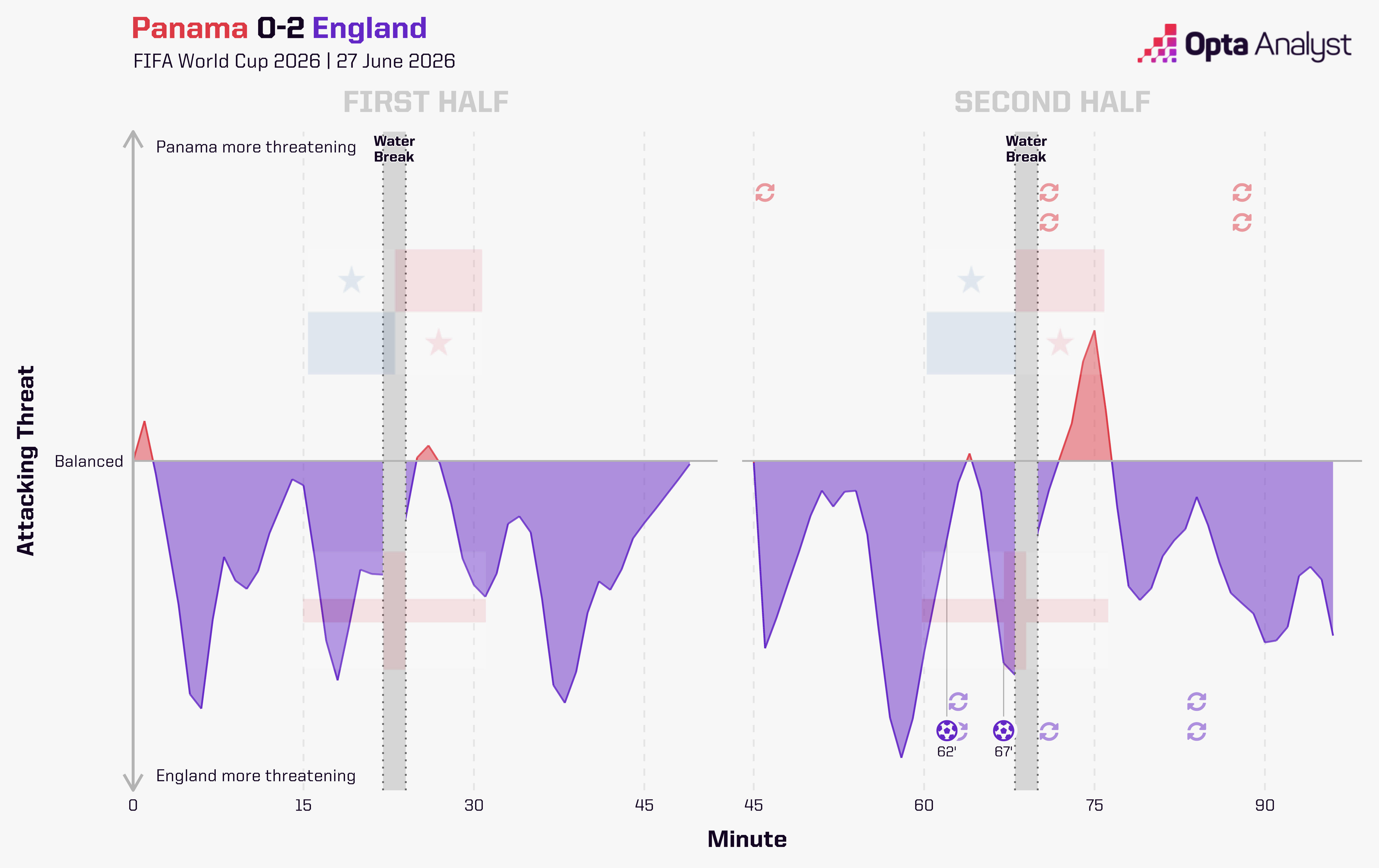
Similarly, against Panama, England's momentum through the 90 minutes was pretty resounding, apart from the minutes directly after the hydration breaks.
Panama's only real moment of pressure came very shortly after the three-minute break in the second half, with England having scored a quick-fire double just before then through Bellingham and Kane.
England v Panama, World Cup momentum graph
Image credit: Opta
So if the victory over DR Congo is a sign of England finding a way to benefit from the enforced stoppages, Tuchel and his side will be pleased that whatever the weather, and with or without in-stadium air conditioning, hydration breaks will continue to feature in every World Cup match this summer.
Add TNT Sports as a preferred source here to enjoy more content like this.
Stream the Premier League, Men’s and Women’s FA Cup, UEFA Champions League, UEFA Europa League, UEFA Conference League and more on TNT Sports and HBO Max.
Related Matches
England
/images.sports.gracenote.com/images/lib/basic/geo/country/flag/large/2208.png)
2
1
DR Congo
/images.sports.gracenote.com/images/lib/basic/geo/country/flag/large/4388.png)
Commentary
Advertisement
Advertisement